Your Brain Is Buffering: The Science of Why Infinite Content Leaves You Feeling Empty

Photo by Photo by Sebastian Romero on Unsplash on Unsplash
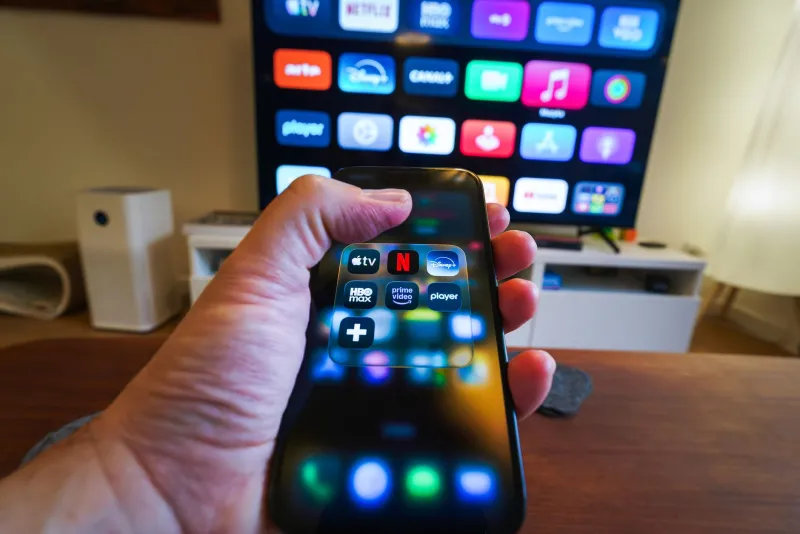
Let's set the scene. It's Friday night. You've got nowhere to be, the couch is calling, and you have access to somewhere north of half a million hours of content across your various streaming subscriptions. Netflix, Hulu, Max, Peacock, Disney+, a few free Tubi channels you forgot about — the whole buffet is open.
And yet, forty-five minutes later, you're watching The Office for the fourth time.
This isn't a personal failure. It's neuroscience. And the story of what's happening inside your skull when you face the modern entertainment landscape is a lot more unsettling than most people realize.
The Paradox Nobody Warned Us About
Back in 2000, psychologists Sheena Iyengar and Mark Lepper ran a now-famous study involving jam. They set up tasting stations at a grocery store — one with 6 varieties, one with 24. The larger display attracted more attention, sure. But shoppers who visited the smaller display were ten times more likely to actually buy something.
More options. Less action. The paradox of choice, as psychologist Barry Schwartz later coined it, is the uncomfortable truth that abundance doesn't make us happier — it makes us freeze.
Now scale that jam study up to 40,000 titles and put it in your living room every single night. That's essentially what the streaming era handed us without a manual.
The cognitive load of choosing what to watch has quietly become one of the most exhausting micro-decisions in American daily life. Decision fatigue — the documented phenomenon where the quality of your choices degrades after a long series of decisions — doesn't care whether you're choosing a Supreme Court ruling or a Tuesday night sitcom. Your brain burns the same glucose either way.
What's Actually Happening in Your Head
Here's where it gets interesting. The prefrontal cortex, the part of your brain responsible for decision-making and self-regulation, is essentially a muscle. And like any muscle, it tires out.
By the time most Americans sit down to watch something in the evening, they've already made hundreds — sometimes thousands — of small decisions throughout the day. What to eat, what to wear, what to reply, what to click, what to skip. The prefrontal cortex is running on fumes.
When you then ask that depleted system to evaluate thousands of entertainment options, rank them against your current mood, cross-reference them with what your partner might want to watch, and commit to a 90-minute investment? It short-circuits. The brain defaults to the familiar. Hence: The Office, again.
Neuroscientists call this the "default mode" fallback — when the brain is overwhelmed or fatigued, it gravitates toward known quantities because the reward pathway is already established. You already know you'll enjoy the Threat Level Midnight episode. There's no risk. No cognitive cost.
The irony is brutal: we built the most sophisticated content delivery systems in human history, and our brains responded by retreating to the comfort of reruns.
The Dopamine Trap Hidden in the Scroll
It gets messier. The act of scrolling through content — not watching, just browsing — actually triggers small dopamine releases. The anticipation of finding something great is neurochemically rewarding, even when you never find it.
Streaming platforms know this. The autoplay previews, the animated thumbnails, the "because you watched" carousels — these aren't features designed to help you find content. They're engineered to keep you in the scroll state, which is engaging enough to hold your attention but not so satisfying that you stop looking.
You're not browsing a content library. You're pulling a slot machine lever, over and over, chasing a jackpot that the platform has a financial incentive to keep just out of reach.
The result? Americans are spending a documented average of 17 to 20 minutes per streaming session just deciding what to watch. That's nearly a third of a standard TV episode burned on the menu screen.
Attention Spans Aren't Shrinking — They're Fragmenting
There's a popular narrative that smartphones and streaming have destroyed our attention spans. The science is more nuanced than that, and honestly, more depressing.
Researchers at the Technical University of Denmark analyzed global attention patterns using large datasets and found that our collective attention span — the window during which a topic dominates cultural conversation — has been narrowing for decades. But individual capacity for deep focus hasn't necessarily disappeared. It's been fragmented.
We're capable of intense concentration. We just can't sustain it across contexts anymore. We watch a show while checking our phone. We half-listen to a podcast while scrolling Twitter. We leave a movie on in the background while doing something else.
The consequence isn't that we can't focus — it's that we've lost the habit of committing. And commitment is the precondition for genuine enjoyment. Psychologist Mihaly Csikszentmihalyi's research on "flow states" — those deeply satisfying pockets of full absorption — requires exactly the kind of undivided attention that the modern entertainment environment actively works against.
Put simply: you can't hit flow while checking Instagram every eight minutes.
The 34-Hour Simulation
Here's a thought experiment. If you could somehow watch everything aggregated across every platform — every new drop, every trending title, every buzzy limited series — simultaneously, you'd need roughly 34 hours a day just to keep up with new content releases in a given week. That's not a joke. The volume of content being produced and distributed across streaming platforms, YouTube, podcasts, and social video has exceeded any single human's capacity to process it by orders of magnitude.
We are, functionally, drowning in content while dying of thirst for something worth watching. The abundance has become its own kind of scarcity.
And the brain, faced with this impossible math, does what brains do when overwhelmed: it checks out. It disengages. It reaches for the remote and puts on something safe.
So What Do You Actually Do About It
Neuroscientists and behavioral economists who study this space offer a few genuinely practical suggestions, none of which involve canceling all your subscriptions (though hey, that works too).
Pre-decide. Make your entertainment choice earlier in the day, when your prefrontal cortex is still fresh. Treat it like a reservation, not a spontaneous decision.
Cap your options. Artificially limit your browsing. Give yourself three choices max and commit to one. The constraint is the point.
Protect your attention. Full-screen, phone face-down, lights dimmed. Create the conditions for absorption rather than hoping it happens despite the distractions.
Embrace the rewatch — strategically. There's nothing wrong with comfort content, but notice when you're choosing it out of genuine desire versus decision fatigue. The distinction matters.
The streaming era promised us everything, aggregated, now. What it quietly delivered was a cognitive tax that nobody put in the terms of service. Your brain isn't broken. It's just running a version of the world it wasn't entirely built for.
Maybe that's worth thinking about. You know, after you finish rewatching The Office.