One Feed to Rule Them All: How News Aggregator Apps Are Quietly Becoming America's Most Powerful Media Gatekeepers
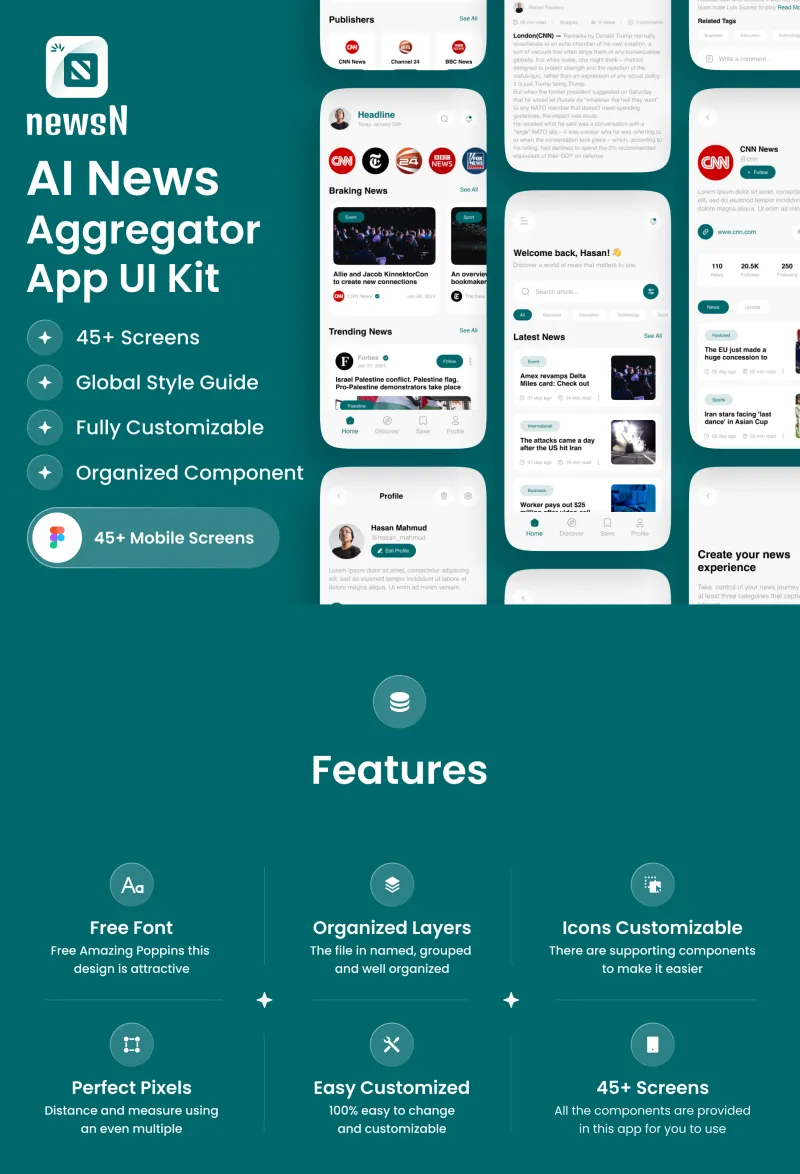
Photo: smartphone news app aggregator multiple headlines digital media feed, via s3.envato.com
There's a good chance you didn't find this article through a newspaper's homepage. You probably didn't type a URL into a browser or flip to a bookmarked site. You tapped a notification, followed a link from a social feed, or landed here through some kind of aggregated content stream. If that's the case, congratulations — you're part of a massive, ongoing shift in how Americans actually consume news, and it's reshaping the entire media industry in ways that most people haven't stopped to think about.
News aggregator apps — platforms that pull headlines, summaries, and links from dozens or hundreds of sources into a single, personalized feed — have quietly become the primary news gateway for a significant and growing slice of the U.S. population. We're talking about apps like Apple News, Flipboard, SmartNews, Ground News, and a handful of others, plus the social-adjacent aggregators like Reddit and even algorithmically curated Twitter/X feeds. According to Pew Research Center data from 2024, nearly 60% of American adults regularly get news from social media or aggregator platforms, with younger demographics skewing even higher.
So what does it mean when the middleman becomes the main event?
The Promise: Everything in One Place
The pitch for news aggregators is genuinely compelling, and it's worth giving it a fair hearing before getting into the complications.
For the average busy American — juggling work, family, a commute, and roughly 47 subscription services — the idea of getting a curated digest of the day's most important stories across politics, business, sports, tech, and entertainment in a single scroll is legitimately useful. Apple News alone has over 125 million monthly active users in the U.S. That's not a niche product; that's a mainstream media habit.
Mike Ananny, a professor of communication and journalism at USC Annenberg who studies algorithmic news systems, has noted that aggregators solve a real problem: information overload. "The volume of news content produced daily is genuinely impossible for any individual to navigate without some kind of filtering layer," he told a media conference earlier this year. "The question is who builds that layer, and what values are baked into it."
For users, the benefits are tangible. Cross-source comparison — seeing how three different outlets cover the same story — is genuinely easier on an aggregator than it is when you're bouncing between individual apps. Ground News, in particular, has built its entire brand around this, showing users the political lean of each source covering a story and flagging when a story is only being covered by outlets on one side of the spectrum. It's a transparency feature that no individual outlet can offer about itself.
The Filter Bubble Problem — And Why It's More Complicated Than You Think
Here's where things get thorny. The same personalization algorithms that make aggregators feel effortlessly relevant are also, critics argue, the engines of a slow-motion epistemic crisis.
Filter bubble theory — popularized by internet activist Eli Pariser back in 2011 — holds that algorithmic personalization creates information echo chambers, feeding users more of what they already agree with and progressively shielding them from challenging or contradictory viewpoints. It's an intuitive idea, and it's been enormously influential in shaping public anxiety about tech platforms.
But the research is messier than the narrative. A 2023 study published in Nature examining Facebook's algorithm found that while the platform did amplify politically congruent content, the effect on actual political polarization was smaller than commonly assumed. Other researchers have pushed back on the filter bubble model entirely, arguing that most Americans are exposed to more diverse viewpoints online than they were in the era of local newspaper monopolies.
What's less disputed is a related but distinct problem: algorithmic bias toward engagement over accuracy. Most aggregator algorithms — like most social media algorithms — are optimized to surface content that gets clicks, shares, and time-on-app. Outrage, novelty, and conflict reliably outperform nuance and context in those metrics. The result isn't necessarily a filter bubble in the ideological sense, but it can be a filter bubble in the emotional sense — a feed that's systematically skewed toward whatever provokes the strongest reaction, regardless of journalistic quality.
"The danger isn't just that people see news that confirms their biases," says media analyst Sara Fischer, who covers the business of media for Axios. "It's that they see news that's been selected for its ability to generate a strong feeling, not its ability to inform."
2024 Usage Data: Who's Using What, and How
The aggregator landscape in 2024 is more fragmented than it looks from the outside. Different demographics are gravitating toward very different platforms, and the usage patterns reveal a lot about what people actually want from aggregated news.
- Apple News dominates among iPhone users aged 35-54, with a skew toward center-to-center-left consumers who want a polished, magazine-style experience. Its human editorial curation layer — a team of editors selects top stories — distinguishes it from purely algorithmic competitors.
- SmartNews has carved out a surprisingly large user base (over 10 million daily active users in the U.S.) among users who explicitly want balanced coverage. Its algorithm is designed to surface stories from both left- and right-leaning outlets, making it a favorite among self-identified independents.
- Reddit functions as a de facto news aggregator for Gen Z and younger millennials, with subreddits like r/worldnews and r/politics serving as community-curated feeds. The upvote system creates a crowd-sourced editorial layer that's chaotic but occasionally more responsive to breaking news than traditional outlets.
- Ground News remains smaller but has seen significant growth (reportedly 300% year-over-year in paid subscribers through 2023-2024) among news-literate users who want meta-level awareness of how stories are being covered across the political spectrum.
The Strategies That Actually Work
Not all aggregator approaches are created equal. Based on what usage data and media researchers tell us, a few patterns separate genuinely useful aggregator experiences from ones that just overwhelm or mislead.
What works:
- Human + algorithm hybrid curation (Apple News's model) consistently rates higher for user trust and satisfaction than pure algorithmic feeds.
- Source transparency — showing users where stories come from and flagging outlet bias — correlates with higher information literacy among regular users.
- Topic-based organization over pure chronology helps users build coherent understanding rather than just absorbing a firehose of disconnected headlines.
- Hard paywalls or clear premium tiers that fund actual journalism, rather than pure ad-driven traffic aggregation, tend to produce better content ecosystems over time.
What doesn't work:
- Infinite scroll with no natural stopping points reliably increases consumption without increasing comprehension or satisfaction.
- Headline-only formats — no summaries, no context — optimize for clickthrough but actively impede informed understanding.
- Hyper-personalization without any serendipity. Users who get only what they've previously engaged with report higher rates of news fatigue and lower confidence in their overall grasp of current events.
The Bigger Picture: Who's Actually in Charge?
Maybe the most important question raised by the aggregator era isn't about algorithms or filter bubbles. It's about power and accountability.
When Apple News decides what's a "top story," it's making an editorial judgment that reaches more people than most newspaper editorial boards ever dreamed of influencing. When SmartNews's algorithm decides that an outlet is "balanced" enough to include, it's making a credibility determination with enormous stakes for that outlet's traffic and revenue. These are editorial decisions. They're just being made by product managers and engineers rather than journalists.
That's not automatically a problem — but it is a new kind of problem, one that existing media accountability structures aren't well-equipped to handle. There's no press council for algorithmic editorial decisions. There's no ombudsman you can write a letter to when you think the feed got it wrong.
For now, the most practical response for news consumers is the same one that's always applied: diversify your sources, question your feed, and remember that convenience has a way of hiding its own costs. The aggregated feed is a tool. Like any tool, what you build with it depends on how consciously you pick it up.
Everything, aggregated, now — that's the promise. Whether it's also the problem is a question worth keeping in your feed.